

We left the last post just when a new rebellion against Danish king Christian II was about to start – the rebellion that would become the Swedish war of independence.
To be fair, there were uprisings in other parts of the country, which had nothing to do with Gustav Vasa. The first rebellion actually took place in Småland. And it soon spread. Gustav was chosen Hövitsman (commander) of Darlarna, but he did not himself participate in battles.
None the less, the rebels soon won important victories and took control of strategic areas. More and more people joined. By spring 1521, Gustav controlled all of Sweden north of Mälaren, and Småland.
Eventually, almost all of the remaining leading noblemen had joined the rebellion, and in August the 25 years old Gustav Eriksson was elected regent of Sweden.

But he still had to defeat the Danish fleet and capture the castles and fortresses, and above all – Stockholm. An army of peasants could not do this. Gustav needed help, both money and troops.
And he knew exactly where to find them…
Gustav turned to the Hanseatic city of Lübeck, where he previously had contacts. Christian II had irritated the merchants by trying to counteract their trade in the Nordic region. It was thus in their interest to break his hold of the area and support the Swedish rebels.
In 1522 they lent Gustav Vasa both troops and money in exchange for trade privileges. With these new resources, Gustav was ready to advance his position.
In January 1523, Christian II was deposed as king of Denmark and Norway, and replaced by his uncle Fredrik I, who tried to claim the throne of Sweden as well.
But by then, Gustav controlled the majority of the country. On June 6th, he was elected king of Sweden. Eleven days later, Stockholm surrendered and on Midsummers Day Gustav Vasa could finally make his entrance into the city to a cheering crowd.
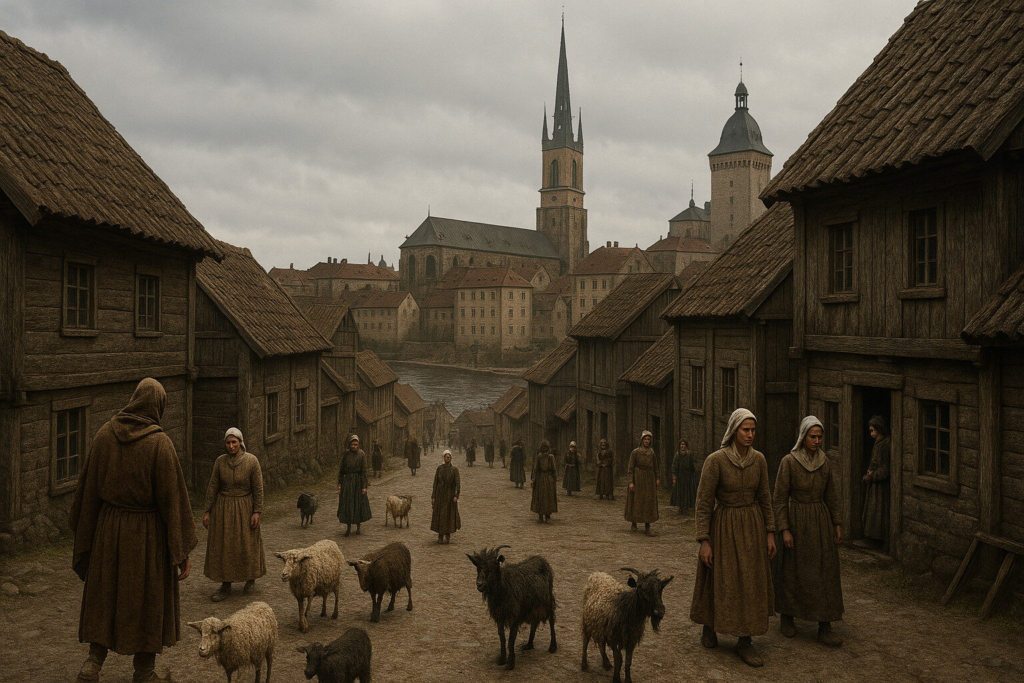
The country that Gustav took control over was a poor and underdeveloped one. Stockholm, the most important city, had a population of around 6000-7000 (compare this to London that had around 40 000, or Paris with 100 000!).
Add to this that there were still some areas – such as Gotland – loyal to Denmark’s new king, Fredrik I. And the fact that Gustav Eriksson was by many seen as a usurper and upstart, with no royal blood or legitimate claim to the throne.
And he had a large debt to Lübeck for their help during the war. They started putting pressure on the new king to pay it back, but the royal coffers were empty.
But then, new thoughts and ideas in the ecclesiastical world spread throughout Europe – and Sweden – criticizing among other things the church’s wealth. In this, Gustav saw a chance to gain both income and power.
A new type of revolution was about to begin…
Sources:
Larsson, Lars-Olof. Gustav Vasa – landsfader eller tyrann? (2002)
Larsson, Olle. Gustav Vasa: en furste bland furstar. (2022)